
Genesis Now Available!
A sample from my debut novel, Genesis

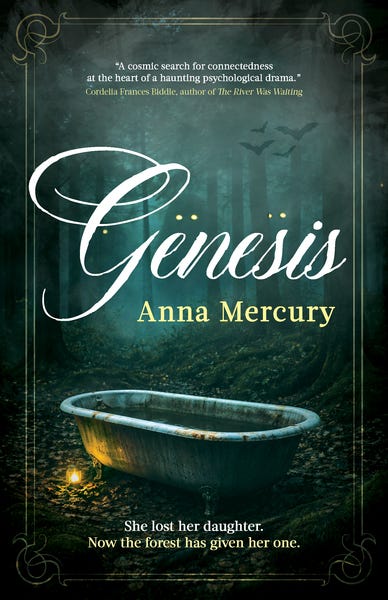
Hello everyone! It has been… twelve years since these characters and their story first walked into my brain, and today, they walk out into the world.
My debut novel Genesis is now available through Vine Leaves Press.
I’d like to extend a huge thank you to the Vine Leaves Press team (and I think some help from a loved one on the other side) for making this happen. I really hope you enjoy this book. I hope you find it useful. Writing it helped me a lot.
Keep scrolling for a summary and a sample:
About Genesis
“A cosmic search for connectedness at the heart of a haunting psychological drama.”
Cordelia Frances Biddle, author of The River Was Waiting
A girl awakens in a bathtub in the woods.
Miles away, Emily Carson’s life has fractured. Her marriage to her husband, Tom, is slowly fading, her life in New York City feels devoid of meaning, and the grief over the loss of her unborn daughter, Julia, has pushed her to the brink of suicide. One evening, as Emily attempts to end her life in her bathtub, something shifts.
Emily and Tom leave the city for the quiet, uneasy upstate town of Asphodel Park, hoping a fresh start will help Emily heal. Instead, the woods behind their new home begin to call to her.
One morning, while walking in the woods, Emily encounters a naked teenage girl who seems to belong to the forest — one who can speak directly into Emily’s mind and lives in fear of dark beasts patrolling the borders of her world. Emily names the girl “Julia” and attempts to bridge the gap between their worlds.
As Emily’s marriage unravels and her grip on reality loosens, her bond with the girl grows stranger and more dangerous, blurring the line between protection and obsession, family and fantasy. Emily must decide which world she belongs to — and what she is willing to sacrifice to stay.
Content warning
Before we get into the opening chapters, I want you to know this story discusses depression, suicidal ideation and attempts, as well as a miscarriage. If any of that is information you don’t feel comfortable dealing with today, that’s absolutely fine, and now would be the time to look away.
Genesis Sample
Chapter 1
The end wasn’t much. There was noise, an endless stream of it coming from the street outside that the thin walls never fully blocked out. There was a cramped one-bedroom apartment. Down the hall, first door on the right, there was a little bathroom with a little bathtub. In the little bathtub was a woman.
Her name was Emily Carson and her life was ending. All of it, her whole history, caught in her throat like the last dregs of a flu. Her mind, it was somewhere. Not there. Not quite. Her arm stretched out before her like a long, deserted road, the horizon splashed with a red sunrise. The light was seeping out of her wrist, dripping over the edge of the world and out.
In her eyes, there was almost something beautiful, as if she stood outside the gate of a golden place that only she could see. But as long as she stood there waiting, the gate never opened, and it never got any prettier than a woman dying alone in a bathtub.
If you asked her why she’d done it, she’d tell you that she wanted to know the truth. If you asked her what lie it was that she was trying to correct, she wouldn’t have been able to say. She wasn’t sure if what she’d done would bring her any closer. It was simply obvious that the truth was absent, that this was an unaddressed deficit, and she was duty bound to do something.
When had she agreed to this contract? Hmm.
The world slipped out of focus as she considered the question. The lights of the bathroom faded like a stage dimming to black. If she had to guess, it began like adventures always do.
It began with a white rabbit.
There was a big cat named Loki who lived next door. The cat was just a cat and not an evil one, but being a cat and all, Loki liked to kill. The rabbit was really more of a bunny, and most of all, a birthday present. Emily was told about responsibility and care, that the rabbit would rely on her for everything, that she was a big girl now. She believed she was, as only a six year old could. She couldn’t pick a name for him, so they just called him Bun. The rabbit didn’t seem to mind.
Emily loved Bun, as six-year-old love goes. She fed him and petted him and tried to teach him tricks. She hopped around the yard with him. She insisted she could teach him how to walk, maybe even fly. You never knew with rabbits.
That morning, the yard was a magic yard and Emily was the fairy queen. She ran upstairs to get her crown from the toy chest. Bun sat in the magic yard, not flying, resolutely obedient to gravity. The magic yard had a magic fence, and the magic fence had a hole. Through the hole came Loki.
Emily watched it from the window. She watched the whole thing. When it was over, she took her crown off her head and threw it in the trash. Her parents, downstairs, didn’t notice. Didn’t see the moment of impact when Emily’s innocence walked quietly away. Their eyes were fixed on the TV, immune to the September morning unfolding outside, watching planes crash into towers.
When Emily was seventeen, the contract gained another clause.
Jake Masters was throwing a Halloween party. His parents, off in Aruba for their annual attempt to save their marriage, had left him alone at the mansion in Greenwich. The only logical response was to clear out the liquor store and invite everyone. Most importantly, the party would be the first time Emily was seeing Kevin Reilly since he’d dumped her on the night of his school’s homecoming. Emily was sick with anxiety. It was only with Julia that the idea of the party sounded fun.
Julia could make anything fun. She was always laughing at something, her wide smile magnified against her dark hair like a searchlight in a storm. Emily had been drawn to her, mothlike to her flame, a planet to her sun, caught up in her orbit.
Julia was driving, as usual. It was another fifteen minutes into Greenwich from Emily’s house. They parked at the end of a long line of cars and climbed the hill up to the Masters’ house on foot.
The first order of business, Julia commanded, was shots. Four of them. That, she said, would be enough of a shield if ever Kevin Reilly showed his greasy, jazz-band head. Emily grimaced and took the tequila like communion wine. In time, the greasy, jazz-band head appeared across the dance floor, and Julia steered Emily away back into the house. Jake’s older brother was on the couch cutting lines of MDMA with his Yale student ID card on an old CD case. Julia grinned at him. He offered her a straw. She offered it to Emily.
At first, there was burning in her nostril. Then, the rush of carsickness, of gravity falling sideways. Then, the sun she orbited began to light inside her. The moth had finally reached the flame, and it was warm and nice in there. She liked it. They went back to the dance floor. Julia tried to kiss her, and Emily let her for a bit. Everyone was staring. They just laughed and danced. When the drugs started wearing off, they stumbled back inside and collapsed into a corner.
“Come on,” Julia said, rising up and tugging at Emily’s arm. “More drugs.” She said it like a cheerleader.
Emily waved her off. It was loud out there. Loud no longer seemed quite so appealing.
“Suit yourself,” Julia shrugged. She went back to the living room to find the CD case.
Emily missed the part where Julia did three lines instead of one. She only caught the part where Julia, twirling around the dance floor, jaw gnawing on air, collided into Kevin Reilly’s greasy, jazz-band head. His jaw was gnawing too. Their jaws started gnawing on each other.
Emily stormed away from the dance floor, out the front door, down the hill. She broke into a run as she heard a car pulling up beside her. It swerved, catching her in the headlights, and screeched to a stop. Julia’s head was leaning out the window.
“Em, I’m sorry, I’m fucked up.”
Emily ignored her and kept walking.
“I would never get with that, you know that.”
Emily stopped. She set her jaw and didn’t look at Julia.
“But you did,” she said.
“Molly did,” Julia said, throwing up her hands. “I didn’t even know where I was. Just get in the car, come on.”
Her words were slurry. Emily knew, deep down, that there was truth in them, but right now, truth could go fuck itself.
“Leave me alone.”
“Em, come on. Don’t be like that.”
She took her shoe off her foot and threw it at Julia. Julia pulled back as it hit the car door and flopped into the street.
“I don’t ever want to see you again,” Emily said, tears now burning in her eyes.
She turned away and kept walking. The car followed her for a while, Julia calling out vaguely. Emily ducked behind a house and walked through the alley instead. When she got back to the road, Julia’s car was gone.
Neither of the girls went back to the party. Emily removed her other shoe and walked barefoot until the sun came up, washed her makeup off in a coffee shop bathroom and quietly snuck back home. Julia got onto the freeway, tried unsuccess- fully to swerve around a semitruck and flipped her Camry three full rolls before it slammed into the wall.
Julia’s mother howled unceasingly all through the funeral. Emily just stared at the casket, wishing they would open it, convinced this all had to be one of Julia’s jokes as they lowered her body into the grave.
The rabbit had long passed out of her mind, leaving a mark she couldn’t trace. With Julia, the mark was visible, dancing on her skin. She kept scratching herself where she thought it lived, right there on her arm, that’s where Julia had to be. She had to have gone somewhere. It was like Emily could smell it, the closeness there to something on the other side. The act of dying held Emily’s attention, the rush of it so strong that Emily felt its breath on her even as it had come for someone else. There was a relationship there now, between her and it, a will-they-won’t-they dance she’d found herself swept into. She was trained on it now and improving in aim, like child learning how to shoot, each time landing closer to the target.
Emily married Tom Carson when she was twenty-four. It had seemed like a great idea at the time, and for the first year or
so, it was. Tomily, their friends had called them, since there had been no way to disentangle the one from the other in those
early days.
At twenty-seven, Emily found herself in the bathroom alone. Nausea had been creeping in, and she wanted to check, just to be sure.
How long had it been since her last … Long enough.
With a deep breath, she opened the package, held the stick under her, and peed on it. She stared at it while it developed, boring a hole with her eyes until, at last, another little blue line appeared.
“Tom?” she called, softly at first. Then louder, bleating.
“Tom!”
He ran to the bathroom door and found Emily sitting on the toilet. He stared wordlessly from her to the stick in her hand, not comprehending. She waved the stick around like a magic wand, willing the silence to break. It worked.
“Oh, Em,” he cried. Two syllables. O-M.
In that moment, they were the most beautiful sounds anyone had ever made. He barreled into the room and grabbed her in a hug. She laughed and cried a little into his stomach, her pants still down around her ankles. His hands twisted into her hair and they became Tomily again.
Tomily shared an incalculable anxious excitement, a perfect unity of emotion held between two distinct bodies. Tomily was going to the doctor the next day. Tomily lay in bed that night, pressed stomach to stomach, with that new and wonderful something growing in between them.
“Boy or girl?” Tom asked.
Emily bit her lip. “Girl,” she said, and somehow she just knew.
“What should we name her?”
“Julia.”
The name was out of her mouth before she even realized, as though someone else had spoken it. Emily laughed at herself. Tom smiled sadly, knowing the story, and nodded. Emily swallowed, feeling an unexpected surge of bile rise at the thought. But of course, that would be her name. Julia would at last come back to life, the place where she belonged.
The weeks that followed were a flurry of appointments and phone calls. They needed a new home. They needed a room for the baby, for Julia. It was too early, the doctor said, to know what sex the baby would be, but Emily was certain. Their lease wasn’t up until the end of spring, but that would still give them enough time to prepare before the baby came. Tom didn’t want Emily to deal with the stress of moving in her last trimester, but she said she didn’t mind. She would be off work by then, she said. Most of the stress in her life would be gone.
The next test told them it would be a girl, and Emily cried in the ultrasound chair. She kissed Tom’s hands, his beautiful hands. Everything would start fresh. All the growing silences that had come to fill their evenings would now be filled with laughter. There would be a new sun for them to orbit, to get the footing back that they’d somehow started losing. Her name would be Julia, and she would have big eyes like Tom’s and a toothless baby smile. Julia.
On Christmas Eve, the pain began. First it was a dull throb, and then it ripped through her body like a weapon. They ran the streets of Bed-Stuy, desperate for a taxi. Emily was bleeding. A lot. Was this normal? It wasn’t normal. They tried to hide the blood from the cabbie as Tom sped him on to the hospital.
Emily woke the next morning in a hospital gown. Tom sat silent in the chair next to her, his head tucked between his hands.
“We lost her” was all he said. “We lost Julia.”
The feeling of it hung inside Emily. It was there in the cracks in the sidewalk, beckoning from a world below her feet. She would catch herself listening to it beneath the rattle of the subway. It was close, just on the other side of that long, yellow line. If she
just stepped off the platform and waited. One, two, three.
The silences with Tom rang louder than ever. His face looked drained of color. Something in his eyes had flickered and died out. The way he held her now felt less like a lover and more like a doctor, his touch perfunctory, like he was feeling around her for a broken bone. She recoiled from it, not because the touch was unwelcome, but because she did feel broken. Every movement hurt. She went to see a nice therapist who gave her nice advice about how to cope with grief. She coped and coped and still, the yellow line beckoned, the threshold beyond which lay the next step. Every time the train lights came through the tunnel, some dark place in her mind counted to three.
As far as anyone knew, the therapy was working. In time, Emily stopped crying herself to sleep. She started running around the neighborhood in the mornings. She showed up at work with a fresher face and brighter eyes. She looked prettier. The hole that was punched through her heart was beginning to close, and there wasn’t so much empty space left. Tom had accepted a new job that would take him out to Long Island most days. He bought a car, a symbol that some long-held identity was wearing thin, but she ignored that for now. He seemed happier. On nights when he came home late, Emily made dinner and they sat by the window and smiled at things again.
The months slipped by in a dull rhythm, and as winter faded the days grew bright and clear.
It was a Thursday in April when Julia would have been due. Emily went to work instead of to the hospital, eight hours spent in a different kind of labor. She tried to focus, but everything swam around her. Her body felt off balance, as though it was certain of what it should be doing instead and confused as to why that wasn’t happening. As Emily left the office, a warm wind seemed to dance across her skin from nowhere, a rush of something passing close at hand.
It happened like this:
Emily got home around six and grabbed a peach off the counter. She cut it up with a knife while she went into the bathroom. The knife sat innocently on the bathroom sink. It was not the knife’s fault.
She studied her face while she ran the bath. The lights at the top of the mirror reflected off her eyes and made them look like a city at night. She thought of her early days, back when New York had felt like a dream. For a moment, the infinitesimal space between one breath and the next, everything was still. The water stopped running and froze in a solid line down from the faucet.
In that breath, Emily understood it all. Every inch of life since life began fit into a neat line, a series of steps aligned like stars to lead up to this point. All she had to do was follow where it led.
She took the knife off the sink and stepped into the water. A warm weight had entered the room, a dark and nameless something, watching her. It was thick in the air, rising in curls of steam from the surface of the bath, breathing her in.
The first cut was too shallow to break skin. A neat little line across Emily’s forearm. The second went deeper. There was
still a little peach juice on the knife. It mixed with a drop of blood and disappeared into the water. Then came the third, and the fourth, and the fifth.
She watched it all from a distance. It came in little bursts.
There was the knife. Where was the peach? There was her arm, and it was red.
Another splash, a skip in time, and there was banging on the door. Then there was blood, so much blood, and water.
Tom was just on the other side of the door, trying the lock and shouting her name. It beat in her brain like a faraway storm. Emily, Emily, Em. Water seeped under the crack.
The world peeled back away from her and left her the edge. A chasm opened at her feet like a wide mouth. In the distance, something blurry. Something opening and gold, and she was almost at the vantage point from which she could see it, see it all, see everything. Let the heavens fall. Let the flood come. This was all that mattered. The truth was nearly upon her, and all she had to do was fall in.
Like slamming into hard ground, the fall stopped short. The door opened. Tom. Face. Mouth, open. Emily. She could see things happening now. They were smudged, moving through a murky pool. Hands, his, lifting her up. There was a phone. There was an ambulance. There was a hospital gown.
And then, like a gasp of air, the world came back into focus. A heart rate monitor blinked beside her, her left arm was bandaged, and Tom was in the visitor’s chair, reaching for her.
“Em,” he kept saying, and touching her arm, and touching his mouth like he was praying. “You’re okay. Baby. What happened?
You’re okay, you’re okay.”
Emily stared at the hospital blanket where her feet poked up beneath it, shaking her head a little like there was water in her ear. The golden thing was gone now. No answers had come. Her arm stung. Tom didn’t let go of her hand all night. There was crying, but she wasn’t sure if she was really into it. They’d asked her a lot of questions, whether she was on medication, if she had a diagnosis. They gave her a pamphlet on adult depression and had her fill out a sheet of paper.
It read: Suicide Plan Risk Assessment Chart.
She looked at that word, suicide. Was that what this had been?
She didn’t want to kill herself. At least, not now.
The chart said: Risk Assessment, slitting your wrists: 6 percent–24 percent effective.
Perhaps, she thought, I attempted 6 percent of suicide.
The whole night, Tom kept her hand between both of his until it disappeared inside. He didn’t cry, but she did. She cried because she missed what she had seen, because for the first time in her life, she’d been so close to it she could touch it. And now, wherever it was, was very far away, on the other side of a chasm she couldn’t cross. She felt her eyes move back into her head. Her breasts rose like the floor of a cave and her hair fell around her as walls. She retreated, watching the world from inside herself. Watching herself watch it. Everything rang and buzzed, somewhere over there.
The warmth faded slowly from the air. It had slipped by again, missing the target. And here was Emily, bandaged and clean and alive, one hand pressed between Tom’s, the other gripping the side of her hospital bed.
Chapter 2
There was nothing. That was the first thing she knew. Then an ocean of light broke open and pushed the nothing down under it, and the nothing cracked the light and became many colors. Gold and green and brown and white and blue. Then the colors cracked and became shapes. The tops of trees, the leaves and clouds, and her. She saw them all and closed her eyes again, blocking out the light. This time, there was not nothing. There was sound. She could hear the wind in the trees. The world was still there, opening.
The sky was a blue circle over her head. The ground was a green circle below. The trees stood around the edges, guarding it, marking the place in-between. Beneath the tallest tree, there was an old white bathtub, the porcelain now permanently stained green and brown. The bathtub was where she began.
This was the way it started that day. She came into the world exactly as she was, no greater or lesser than this. There was no before, no after to come. All she saw was the light of the sun, the trees swaying slowly, in a time young enough that heartbeats still felt slow.
The bathtub was full of dirt and old leaves. She lifted her hands to her face and let the leaves fall through her fingers. Her hands were dirty and raw. Her body hurt. She dug deeper into the leaves and let them keep her warm.
Eventually, she stood up on that first morning, though it pained her to move. She tripped over the edge of the bathtub and landed on the ground. The sticks buried into her skin. She heard herself cry out, her own sound, for the first time. It drowned the other sounds of the birds in the trees and the wind. She lay there with her cheek against the dirt, waiting for something to happen.
Many things happened, but not to her.
The trees widened out their leaves and pushed their crowns up towards the light. A thousand beings hummed and danced in the hollows of the wood. The sun moved in the sky, and everything was moving but for her. Then, all at once, something stirred her. She felt it before she saw, that she was looking at something that was looking at her.
She pushed herself up and wiped the dirt off her face so she could see it better. It was on the edge of the clearing, huge and black, rumbling through the trees like a storm cloud. If it hadn’t been for the breathing, she would’ve said that was what it was. She turned, and there were more of them, all the way around the circle, looking at her. She wondered if her cry had brought them, or if they’d always been there. Between every gap in the trees, she could just see another one: a great beast with black fur and yellow eyes, watching her.
Her breath caught in her throat. The beasts circled the wood around her, appearing here and there before vanishing into the trees again. Night fell and still she did not move. She could hear their footfalls echoing. Echoing still. Her body hurt. She was hungry, so hungry she almost wished the beasts would come for her, if for nothing than just to be food.
The beasts did not come for her, and still, they did not leave.
There was nowhere for her to run away from them. There were no gaps in the circle they made. They were always everywhere, even when she was alone and closed her eyes. Especially there. When she looked up, their yellow eyes were the stars in the sky. When she looked down, their dark faces were peering back from in between the leaves. When they moved in toward her, she flinched, awaiting the teeth ripping into her skin, but the teeth never came. When they moved away from her, she missed them.
She knew, somehow, that the beasts were there to protect something — not her, not necessarily. They protected the edge, the wall between where she was and whatever lay beyond. They kept all the dangers and wonders outside from getting in.
She stayed in the bathtub as time melted and dripped away. The sky rained down and she opened her mouth to catch it. She shivered all into the night.
In the morning, the sun broke the darkness again, but it didn’t split the world like it had on the first day. The world remained unfixed. There were no lines between colors or shapes. She could feel herself slipping away, hear the beasts breathing harder, waiting, eager.
Then, something clear came through the imprecise light and danced in front of the bathtub. Something gold. She blinked at it. A bird. It landed upon a pile of bricks near where the bathtub stood and looked at her, turned its head this way and that, as if taking her in. Then it opened its beak and spoke.
“You must learn to survive here,” the golden bird said. “You must gather food and hunt. You must get up and try.”
She knew then that she was close to falling back out of existence. She couldn’t imagine doing what the bird had asked of her. The bird opened its wings and flapped them, stirring the leaves, creating movement. Slowly, she gripped the edges of the bathtub and lifted herself up.
The bird flew ahead of her and showed her the way. As she walked, the beasts parted, giving her room to pass. The bird landed on the branch of
a fruit tree and made the fruit fall at her feet.
It told her to follow again and flew until it perched above a rabbit burrow. It told her to reach into the burrow and pull a rabbit out. She did as she was commanded, felt them scurry around inside until her fingers closed around warm fur and she pulled out something small and white. The bird told her to break the rabbit’s neck. It struggled in her hands. She could feel its wild heartbeat, the rhythm almost too much to contain, but with her eyes on the bird, she set her jaw and twisted the rabbit’s neck until the frantic movement stopped. The bird led her down to a stream where she could drink fresh water. It told her to skin and clean the rabbit, then light a fire, and she did. When it was cooked, she ate.
“Everything you need is here,” the bird said. “In here, it’s all in balance. You must treat it with respect and honor, the order of things. If you disturb the balance, you will lose it all. Do you understand?”
She nodded, still holding the rabbit’s bones lightly in her hand. The golden bird rose higher and she watched as its color seemed to spread, its shape growing less defined. She watched until the imperceptible moment when the golden bird melted into the golden sun, the one became the other, and the woods were empty but for her and the rabbit bones.
But as she looked around her, she could see them there again, filling every empty space in between the trees. The beasts were still there, watching, patrolling the edges of the world.
Your way with words is so evocative. I can't wait to read the rest of the book! Congrats on getting it published!